




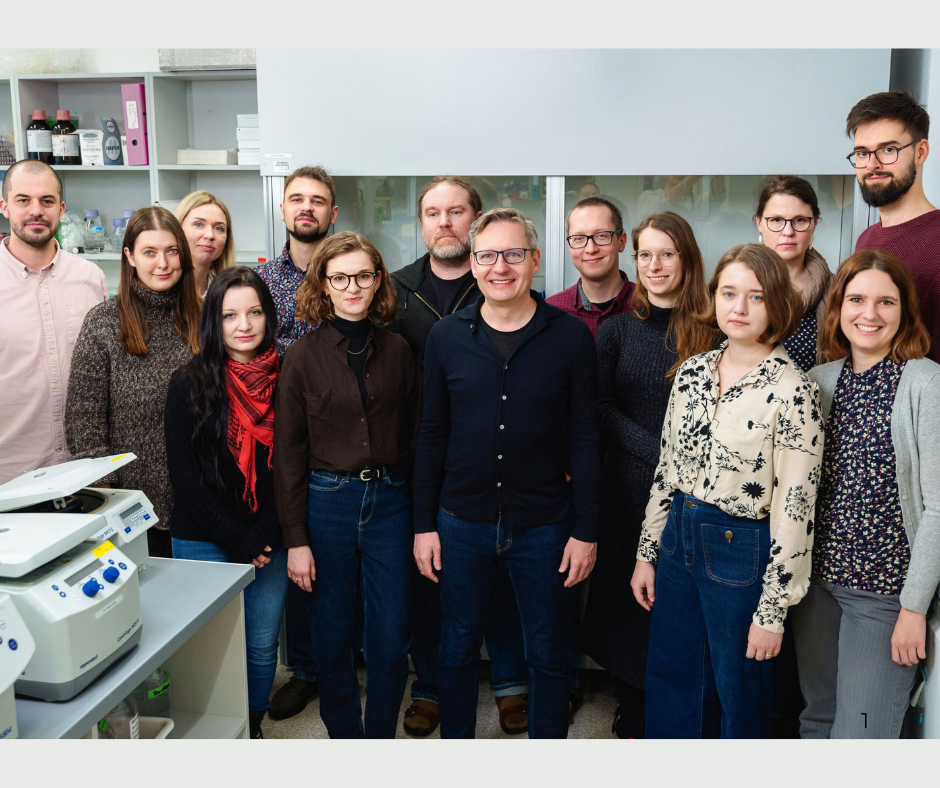
Prof. Włodzimierz Krzyżosiak Award for IIMCB researchers for their Nature paper
Why do mRNA vaccines remain active in cells for longer and work more effectively? The answer comes from a study by IIMCB scientists, published in Nature in collaboration with researchers from the University of Warsaw, the Institute of Biochemistry and Biophysics of the Polish Academy of Sciences, the Medical University of Warsaw, and ExploRNA Therapeutics.
The authors have now received the Prof. Włodzimierz Krzyżosiak Award, presented by the Committee of Molecular Cell Biology of the Polish Academy of Sciences for the best experimental study on nucleic acids conducted in a Polish laboratory and published in a given year — in this case, 2025.
Why mRNA remains active for longer
In the award-winning paper, “Re-adenylation by TENT5A enhances efficacy of SARS-CoV-2 mRNA vaccines”, the researchers described the mechanism responsible for this effect.
A key role is played by the TENT5A enzyme, which extends the poly(A) tail at the end of an mRNA molecule. This makes the mRNA more stable and allows it to remain active for longer, enabling cells to produce more antigen — the protein that triggers an immune response.
The role of macrophages
The team also showed that macrophages play a particularly important role following vaccination. These immune cells take up the mRNA and use it to produce the antigen.
Understanding how TENT5A works could contribute to the development of more effective vaccines and other mRNA-based therapies.
Authors
The first author of the study is Paweł Krawczyk, PhD, while the corresponding authors are Prof. Andrzej Dziembowski and Seweryn Mroczek, PhD, DSc.
Other IIMCB researchers who contributed to the study include Michał Mazur, Wiktoria Orzeł, Olga Gewartowska, Sebastian Jeleń, Wiktor Antczak, Karolina Kasztelan, Aleksandra Brouze, Katarzyna Matylla-Kulińska, Natalia Gumińska, Bartosz Tarkowski, Ewelina P. Owczarek, Kamila Affek, Małgorzata Sroka, and Monika Kusio-Kobiałka. Some of them are also affiliated with the Faculty of Biology at the University of Warsaw.
A second distinction
In the same competition, Prof. Andrzej Dziembowski also received a distinction as a co-author of the article “Chemical circularization of in vitro transcribed RNA for exploring circular mRNA design”, published in Nature Communications.
The Nature paper is available here:
https://www.nature.com/articles/s41586-025-08842-1
The Nature Communications paper is available here:
https://www.nature.com/articles/s41467-025-61775-1
This information was prepared based on materials provided by the Promotion Office of the Faculty of Biology at the University of Warsaw.