




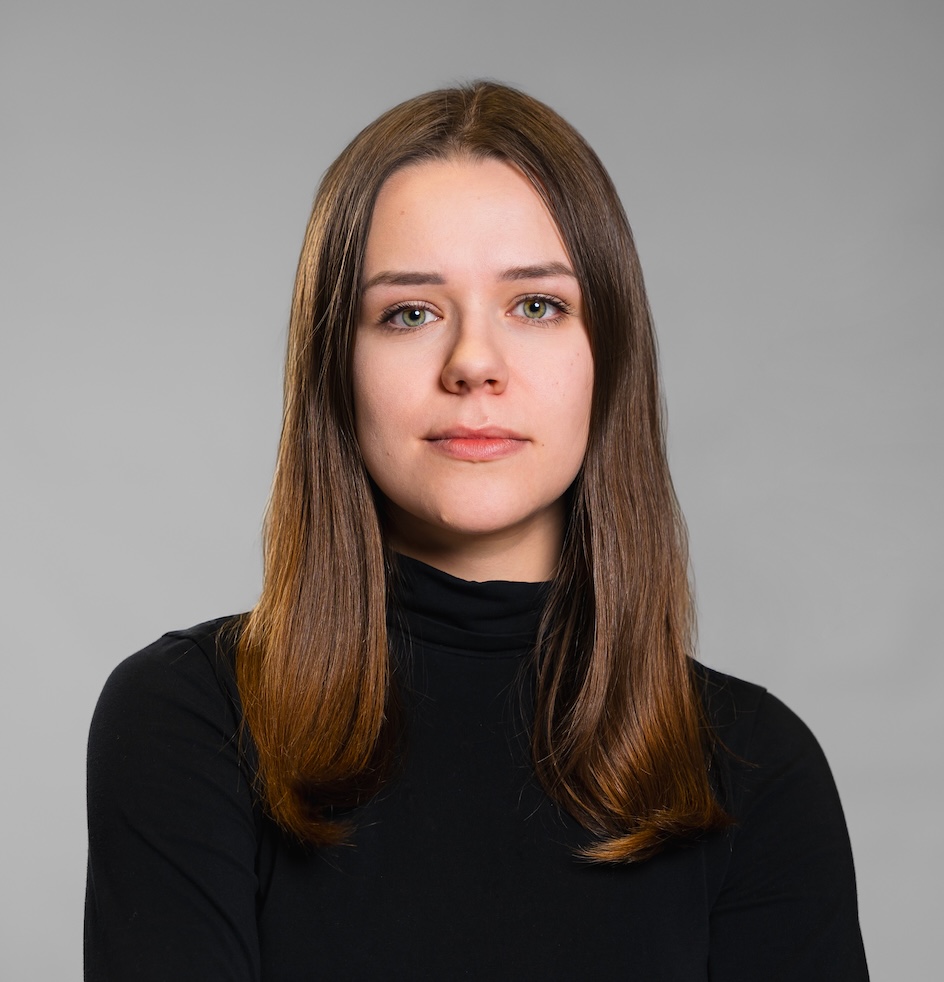
IIMCB bioinformatician and finalist of NATO’s international competition “Women and Girls in Science 2026”, Konstancja Gałat, talks about addressing the antibiotic resistance crisis, using artificial intelligence to design phage therapies, and why breakthrough ideas often emerge at the intersection of different scientific disciplines.
Please introduce yourself and tell us what you work on day-to-day.
My name is Konstancja Gałat. I am a PhD student at the International Institute of Molecular and Cell Biology in Warsaw. I work in bioinformatics and analyze large-scale data that we generate together in the Laboratory of Cellular Genomics.
We study interactions between the liver and the gut, with a particular focus on the role of the microbiota. We explore how changes in bacterial composition and intestinal physiology affect liver cells and how liver health contributes to intestinal homeostasis. I focus specifically on how cirrhosis-related disturbances affect absorption processes. Interestingly, my work is entirely computational.
My project grew out of a specific and quite common medical problem: worldwide, a significant proportion of patients with liver cirrhosis suffer from malnutrition. Our hypothesis is that this results from impaired intestinal absorption, since these organs are closely interconnected. We are investigating this using two mouse models.
What prompted you to take part in the “Women and Girls in Science 2026” challenge organized by the NATO Science and Technology Organization?
I entered because my experience with bacteriophages and the microbiome aligns well with the competition themes. I enjoy engaging in such activities and believe it's important to share unique perspectives.
The competition was based on five fictional scenarios, such as “A Day Without the Internet” or “A Day Without Antibiotics.” You chose the latter. Your project is titled “Resilient Response to an Antibiotic Crisis Through Rapid Diagnostics and Decentralized Phage Therapies.” Why this topic? Was it simply because it matched your research interests?
Yes, because I felt most confident in this area and see alternatives to antibiotics as essential, given the urgent bacterial resistance crisis.
Decentralized phage therapies mean treating bacterial infections with bacteriophages — viruses that attack specific bacteria. “Decentralized” means that instead of producing such therapies only in one large center, they could be prepared closer to the crisis site, wherever diagnostics indicate which bacteria pose the greatest threat.
So, decentralized phage therapies are your concept and your contribution to the competition?
Yes. My proposed solution combines two elements: large-scale detection and improved bacteriophage production. At present, the use of phages still involves certain bottlenecks. However, I believe that with access to large volumes of bacterial data and the development of new tools, these two areas could complement each other and gradually reduce existing barriers.
If we imagine an outbreak of a fully antibiotic-resistant infection, how would you see such a therapy working in practice — for an average person ten years from now?
It would certainly have to be personalized. An antibiotic is usually a pill, but bacteriophages are more complex. First, we would need to determine exactly which bacterial species is causing the problem. This could be done, for example, through genome sequencing.
The next step, instead of the traditional process of isolating bacteriophages from sewage and then testing them in the laboratory, could involve using sequencing data and AI-based protein modeling tools. This would allow us to model bacterial surface proteins and bacteriophage receptors computationally, which is far more scalable than laboratory testing.
After that, so-called bacteriophage cocktails could be produced — combinations of several different phages targeting specific bacterial structures in order to prevent the bacteria from making an “evolutionary escape” from the therapy.
Submissions were assessed in terms of innovation, relevance, coherence, feasibility, and societal impact. Which of these is the strongest aspect of your project?
I think of feasibility and out-of-the-box thinking. Other finalists are focusing on peptides or phages alone, but these solutions cannot be implemented immediately. My detection step is easier to deploy and, strategically, could enable the isolation of infected patients whom we are not yet able to treat.
How does it feel to know that you are going to Brussels, to NATO Headquarters, to present your idea?
It is a great honor and a huge source of stress. I am practicing my presentation all the time. I am very happy to be representing our Institute and to be able to bring someone with me for support.
Experts in battlefield medicine consider massive bacterial infections to be among the most dangerous “killers.” The ability to respond to them quickly without using antibiotics could be a game-changer, couldn’t it?
Absolutely. A lack of antibiotics would affect not only the treatment of civilians and soldiers, but also animals. This would strike three strategically crucial areas: public health, national security, and food security. It would cause enormous panic.
Having a solution that could be deployed almost immediately might help reassure the public during a crisis.
The final agenda includes a discussion on diversity of thought. Why, in your view, is diversity of perspectives so important?
Today, scientists often work in very narrow fields. That is why it is important to connect different areas of knowledge and bring together different perspectives, because this approach supports the emergence of non-obvious and promising solutions.
Every person has different experiences, and confronting them with one another allows us to develop ideas that are unexpected and often groundbreaking.
As a finalist, you will be invited to join the STEM Forward community. How would you like to use this opportunity?
It is a great networking opportunity. I would like to confront my research with people from other sectors and research areas. In the laboratory, our field of view can sometimes become quite narrow, while people from different parts of the world may have interesting ideas that we would not have come up with ourselves.
What advice would you give to other women who are considering a career in defense or would like to apply to this competition?
I would advise them to try their hand at different initiatives. It is worth finding the time, because science is not only about conducting research and writing papers, but also about communication and making yourself visible to the wider world.
This helps others notice our work, and it can also strengthen public trust in science.
Thank you very much for the conversation.