




We study RNA not only as a carrier of genetic information, but also as a class of dynamic molecules that actively shape biological processes at the molecular level. We approach RNA as a complex puzzle in which every element provides clues to its diverse functions, ranging from the catalysis of chemical reactions to the regulation of cellular processes. Using advanced computational models and experimental techniques, we investigate RNA structures and interactions, particularly those involving proteins and small chemical molecules.
Research Summary
Our research focuses on developing and applying new methods for determining RNA structures and modeling interactions between RNA and other molecules. We combine computational predictions with experimental analyses to gain a better understanding of the roles played by RNA in biological processes. This integrated approach makes an important contribution to molecular biology, bioinformatics, and structural biology.
The computational tools developed by our laboratory, including ModeRNA and SimRNA, are widely used by researchers around the world. We investigate the three-dimensional structures of RNA molecules originating from viruses, bacteria, and human cells, with particular emphasis on molecules that may serve as targets for small chemical compounds. Our research is conducted in close collaboration with research groups and partners in Poland and abroad.
Scientific Impact
- Development of tools for modeling RNA structures and their interactions with small chemical molecules.
- Continued development of the MODOMICS database, which celebrated its 20th anniversary in 2025.
- Participation in the international Human RNome Project consortium.
- Expansion of the MODOMICS database to include thousands of human transcript sequences with mapped RNA modifications.
- Development of new computational tools for comparing three-dimensional nucleic acid structures and identifying structural motifs.
- Determination of the three-dimensional structures of diverse RNA molecules using cryo-electron microscopy combined with computational modeling.
Research Plans
Our objective is to deepen the understanding of RNA structure and function, particularly by investigating molecules with potential therapeutic relevance. The computational methods we develop, integrated with experimental studies, are intended to support both advances in fundamental research and future practical applications.
In the long term, we aim for our work to contribute to the advancement of scientific knowledge and to the development of solutions relevant to medicine and biotechnology.
Collaborations
- Cryo-electron microscopy and RNA structure: S. Glatt, Poland/Austria; Z. Su, China
- Circular dichroism and FTIR spectroscopy of RNA: V. Arluison and F. Wien, France
- RNA modifications: Human RNome Project Consortium
- RNA structure comparison: E. F. Baulin, Poland
Comment
“Our goal is to determine RNA structures and interactions and to design new molecules with functions relevant to medicine and biotechnology. We combine cryo-electron microscopy with biochemical studies and computational modeling to determine the three-dimensional structures of diverse RNA molecules.
We have developed new computational tools for comparing three-dimensional nucleic acid structures and identifying structural motifs. To mark the 20th anniversary of MODOMICS in 2025, we substantially expanded the database by adding thousands of human transcript sequences with mapped RNA modifications. We are continuing this effort in collaboration with the Human RNome Project consortium,” says Prof. Janusz M. Bujnicki.
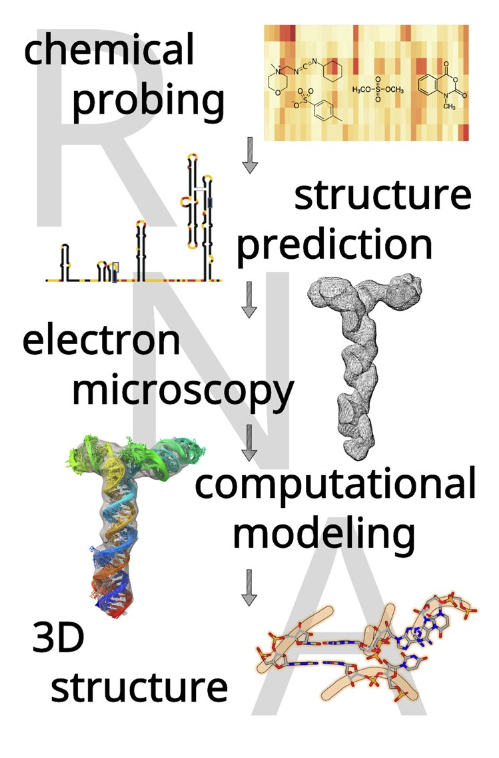
Determination of RNA 3D structure and dynamics, using a combination of computational and experimental methods. Example for the 5′-proximal region in SARS-CoV-2 RNA.
(Illustration: Dr. Tales Rocha de Moura)
Visit the laboratory website for more details: https://genesilico.pl/
Publications and preprints from this group
Browse publications → 
Lab Leader
Prof. Janusz M. Bujnicki
Senior Researchers
Dr Elżbieta Purta
Dr Filip Stefaniak
Dr Tales Rocha de Moura
Postdoctoral Researchers
Dr Gregory Nikolaev
Dr Rui João Loureiro
Software Developers
Dr Masoud Amiri Farsani
Seyed Naeim Moafinejad, MSc
Research Assistants
Agata Bernat, MSc
Dominik Sordyl, MSc
Anastasiya Shavina, MSc
Research Technician
Iwona Ptasiewicz
Laboratory Support Specialist
Katarzyna Grzelak, MSc
Students
Zuzanna Lubas, BSc
Zuzanna Stasiak, BSc
Klaudia Bodych, BSc
Volunteers
Dr Satyabrata Maiti
Dr Sunandan Mukherjee
Dr Kuntal Mondal
Dr Angad Sharma
 |
Janusz M. Bujnicki, PhD, ProfessorCorrespondence address: |
DEGREES
2009 - Professor of Biological Sciences, nomination by the President of the Republic of Poland
2005 - DSc Habil in Biochemistry, Institute of Biochemistry and Biophysics, Polish Academy of Sciences, Warsaw, Poland
2001- PhD in Biology, University of Warsaw, Faculty of Biology, Poland
1998 - MSc in Microbiology, University of Warsaw, Faculty of Biology, Poland
PROFESSIONAL EXPERIENCE
2002-present - Professor, Head of Laboratory of Bioinformatics and Protein Engineering, International Institute of Molecular and Cell Biology in Warsaw, Poland (100% appointment)
2019-present - Scientific Advisor, Łukasiewicz Research Network - PORT Polish Center for Technology Development (25% appointment)
2006-2020 - Associate Professor (extraordinarius), Bioinformatics Laboratory, Institute of Molecular Biology and Biotechnology, Adam Mickiewicz University, Poznań, Poland
2010-2011 - Deputy Director, International Institute of Molecular and Cell Biology in Warsaw (1 year rolling position)
2008 - Visiting Professor, University of Tokyo, Japan(sabbatical)
2004-2006 - Assistant Professor, Adam Mickiewicz University, Poznań, Poland
2001 - Visiting Scientist, National Center for Biotechnology Information,National Institutes of Health, Bethesda, Maryland, USA
1999-2002 - Research Scientist, Bioinformatics Laboratory, International Institute of Molecular and Cell Biology in Warsaw, Poland
1998-2000 - Senior Research Assistant, Henry Ford Hospital, Detroit, Michigan, USA
SELECTED PROFESSIONAL AFFILIATIONS
2019-2022 - Member, Committee for Science Evaluation, Ministry of Science and Higher Education
2020 - Member, Advisory Group on Preventing, Counteracting and Combating COVID-19, Ministry of Science and Higher Education
2019-present - Member, University Council, University of Warsaw (Chairman, 2019-2020)
2018-present - Member, Academia Europaea
2018-present - Member, European Molecular Biology Organization
2017-present - Member, European Science Advisors Forum
2016-present - Corresponding Member, Polish Academy of Sciences
2016-2017 - Member, Council of the National Science Congress
2015-2020 - Member, Group of Chief Scientific Advisors, European Commission’s Scientific Advice Mechanism
2014-2018 - Member, Scientific Policy Committee, Polish Ministry of Science and Higher Education
2013-present - Executive Editor, Nucleic Acids Research
2013-2016 - Member, Scientific Committee of the Innovative Medicines Initiative
2013-2015 - Member, Science Europe: Life, Environmental and Geo Sciences (LEGS) Scientific Committee
2011-2016 - Member, Polish Young Academy, Polish Academy of Sciences
2007-present - Member, Polish Bioinformatics Society (founding member; Vice-President, 2007-2010; President, 2011-2013)
2007-present - Member, RNA Society
2001-present - Member, International Society for Computational Biology (Senior Member, 2015-)
SELECTED AWARDS AND FELLOWSHIPS
2019 - André Mischke Young Academy of Europe Prize for Science and Policy Honorary Award "For Merits for Inventiveness," Prime Minister at the request of the Polish Patent Office
2019 - Award for Organizational Achievements, Ministry of Science and Higher Education
2017 - Crystal Brussels Sprout Award
2015 - Jan Karol Parnas Award of the Polish Biochemical Society
2014 - National Science Centre Award for outstanding scientific achievements
2014 -Master Award, Foundation for Polish Science
2014 - Prime Minister’s Award for outstanding scientific achievements
2014 - Selected as one of “25 leaders for the next 25 years” by Teraz Polska magazine of the Polish Promotional Emblem Foundation
2014 - Knight's Cross of the Order of Polonia Restituta
2014 - Award in the Science category of the national plebiscite “Poles with Verve”
2013 - ERC Proof of Concept Grant
2012 - Award for Outstanding Research Achievements, Ministry of Science and Higher Education
2010 - ERC Starting Grant (2011-2015)
2009 - Scholarship for Outstanding Young Scientists, Minister of Science and Higher Education
2009 - Award for Research Achievements, Ministry of Science and Higher Education
2006 - Prime Minister Award for habilitation thesis
2006 - Young Researcher Award in Structural and Evolutionary Biology, Visegrad Group Academies of Sciences
2003, 2004 - START Scholarship for Young Scientists, Foundation for Polish Science
2002-2005 - EMBO/HHMI Young Investigator Award
2002 - Award for best Polish genetics-related publication in 2002, Polish Genetics Society
2001 - Award for best Polish publication on nucleic acid biochemistry in 2000, Polish Biochemical Society and Sigma-Aldrich
DOCTORATES DEFENDED UNDER LAB LEADER’S SUPERVISION
A. Żylicz-Stachula, A. Chmiel, I. Cymerman, A. Czerwoniec, M. Gajda, M. Pawłowski, J. Sasin-Kurowska, J. Kosiński, A. Obarska-Kosińska, S. Pawlak, E. Purta, K. Tkaczuk, Ł. Kościński, M.Rother, W. Potrzebowski, I. Korneta, T. Puton, J. Kasprzak, I. Tuszyńska, Ł. Kozłowski, M. Werner, A. Kamaszewska, A. Philips, K. Milanowska, M. Piętal, D. Matelska, K. Majorek, M. Domagalski, T. Osiński, M. Machnicka, M. Magnus, K. Szczepaniak, M. Zielińska, Astha, I. Foik, D. Toczydłowska-Socha.