




Our laboratory investigates how cells maintain the proper state of their proteome, meaning the full set of proteins present in a cell. This process is known as proteostasis. We are particularly interested in the spatial and temporal regulation of protein degradation mechanisms in mammalian cells, especially those mediated by the ubiquitin-proteasome system.
We aim to understand how defects in protein quality-control systems contribute to the development of neurodegenerative diseases, such as Alzheimer’s, Parkinson’s and Huntington’s disease. Because proteostasis failure may begin long before clinical symptoms appear, studying the earliest cellular changes is essential for designing future therapeutic strategies.
Research Summary
The cellular proteome is highly complex. It consists of thousands of proteins that must be properly synthesized, folded, transported to the right location and removed when they are damaged or no longer needed. This balance is maintained by coordinated protein quality-control systems, including the ubiquitin-proteasome system, autophagy and other degradation and repair pathways.
The laboratory focuses on the mechanisms responsible for protein clearance and on how these mechanisms are regulated in different cellular compartments. A particularly important area is nuclear proteostasis, meaning the mechanisms that maintain protein quality in the cell nucleus, and its links with cytoplasmic degradation pathways.
One of the central research questions is how the ubiquitin-proteasome system functions in the nucleus and how it communicates with protein quality-control systems operating in the cytoplasm. Disrupted communication between these networks may contribute to the accumulation of toxic protein aggregates, a hallmark of many neurodegenerative diseases.
To study these processes, the laboratory uses modern molecular biology techniques, high-throughput CRISPR/Cas9 screening, quantitative mass spectrometry, advanced fluorescence microscopy and models of neurodegenerative diseases based on human neurons differentiated from induced pluripotent stem cells. .
Another important focus is VCP/p97, a key unfoldase involved in protein quality control. The laboratory investigates how disease-linked mutations may affect VCP function and promote tau accumulation in frontotemporal dementia.
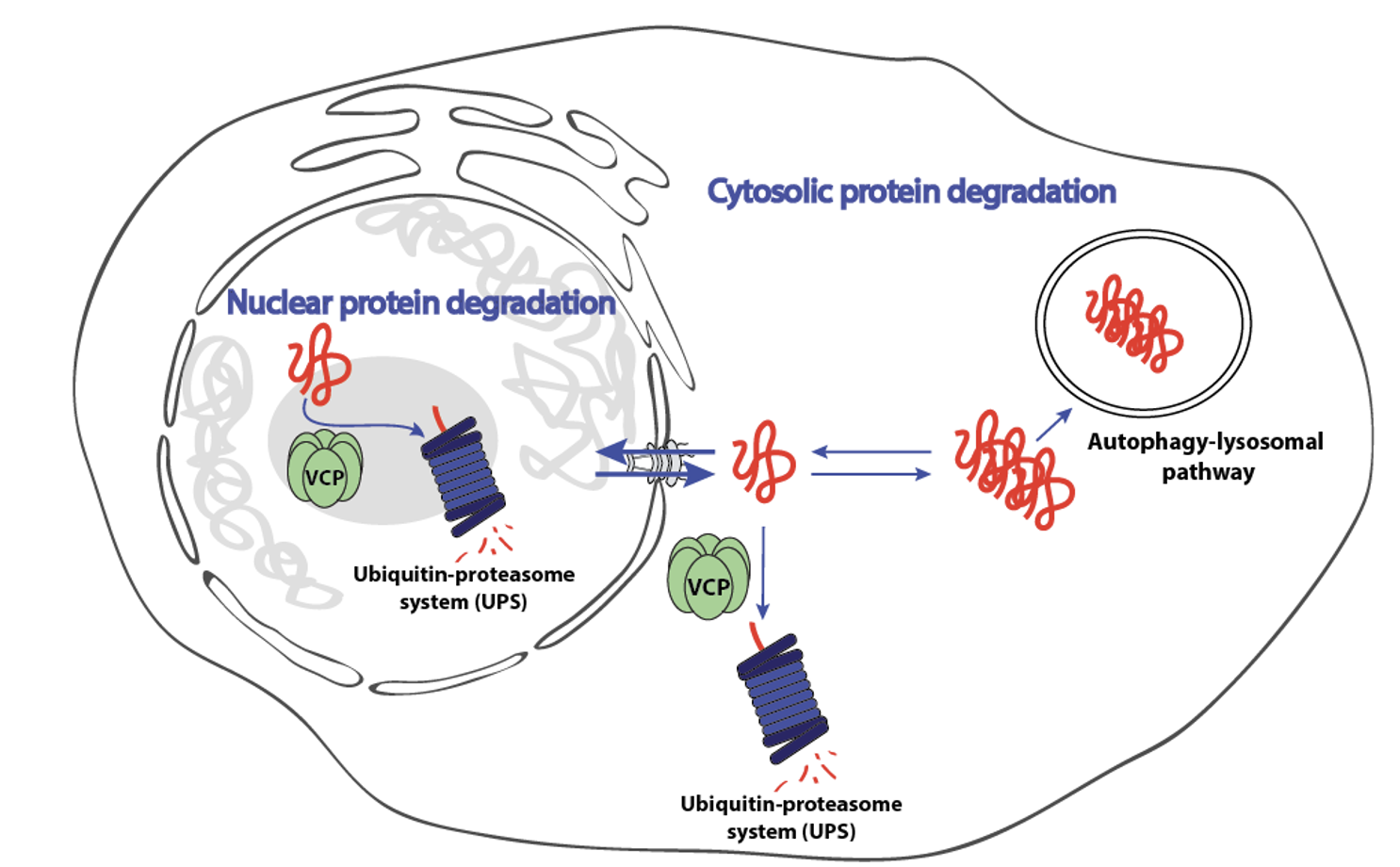 Fig.: Primary pathways for protein degradation in the cytosol and nucleus
Scientific Impact
- Identification of mechanisms regulating nuclear proteostasis and their links with cytoplasmic protein quality pathways.
- New insights into how defects in protein clearance pathways contribute to the pathology of neurodegenerative diseases.
- Development and application of human neuronal models to study disease-associated proteostasis defects.
- Search for new regulators, substrates and points of communication between nuclear and cytoplasmic protein quality-control systems.
Research Plans
Our goal is to determine how the ubiquitin-proteasome system operates in the cell nucleus and how nuclear proteostasis is integrated with broader cellular protein quality control. We will investigate how defects in these systems lead to the accumulation of toxic protein aggregates, one of the characteristic features of many neurodegenerative diseases.
Using genome-wide CRISPR/Cas9 screening and methods for tracking endogenous protein trafficking, we aim to identify new regulators of protein degradation, define their substrates and explain the mechanisms of communication between nuclear and cytoplasmic degradation pathways. In parallel, we study VCP to determine how disease-linked mutations lead to tau accumulation in frontotemporal dementia.
Ultimately, we aim to identify new molecular therapeutic targets that could help restore proteostasis in disease-affected tissues.
Collaborations
We are collaborating with Prof. Andrew Wood (University of Edinburgh) on the development of a new compartment-specific targeted protein degradation system. We are also actively seeking interdisciplinary collaborations linking molecular proteostasis research with translational neurobiology.
Comment
“We aim to explain the spatial and temporal regulation of protein clearance by the ubiquitin-proteasome system, discover new mechanisms of nuclear protein quality control and its coordination with cytoplasmic pathways, and identify proteostasis defects driving neurodegeneration.” Dr Lidia Wróbel, Head of the Laboratory of Cellular Proteostasis.
Laboratory Webpage

Publications and preprints from this group
Browse publications →
 |
Lidia Wróbel, PhDCorrespondence address: |
DEGREES
2015 - PhD in Biological Sciences, Nencki Institute of Experimental Biology, Warsaw, Poland
2009 - Msc in Biotechnology, Warsaw University of Life Sciences, Poland
PROFESSIONAL EXPERIENCE
2024 - present - Head of Laboratory of Cellular Proteostasis, International Institute of Molecular and Cell Biology in Warsaw, Poland
2016 - 2024 – Postdoctoral training in the group of Prof. David Rubinsztein, University of Cambridge, United Kingdom
2010 - 2015 – Research in the group of Prof. Agnieszka Chacinska, International Institute of Molecular and Cell Biology in Warsaw, Poland
2008 - 2009 – Erasmus research project at Ghent University, Belgium
HONORS, PRIZES AND AWARDS
2025- Habilitation fellowship of L’Oréal Poland for Women in Science
2025 - EMBO Installation Grant
2016 – EMBO Long Term Fellowship