




Our laboratory studies the molecular mechanisms of post-transcriptional gene regulation in bacteria, particularly under stress conditions and during bacteriophage infection. We are interested in how RNA-binding proteins and small regulatory RNAs control translation, RNA degradation and bacterial adaptation to changing conditions.
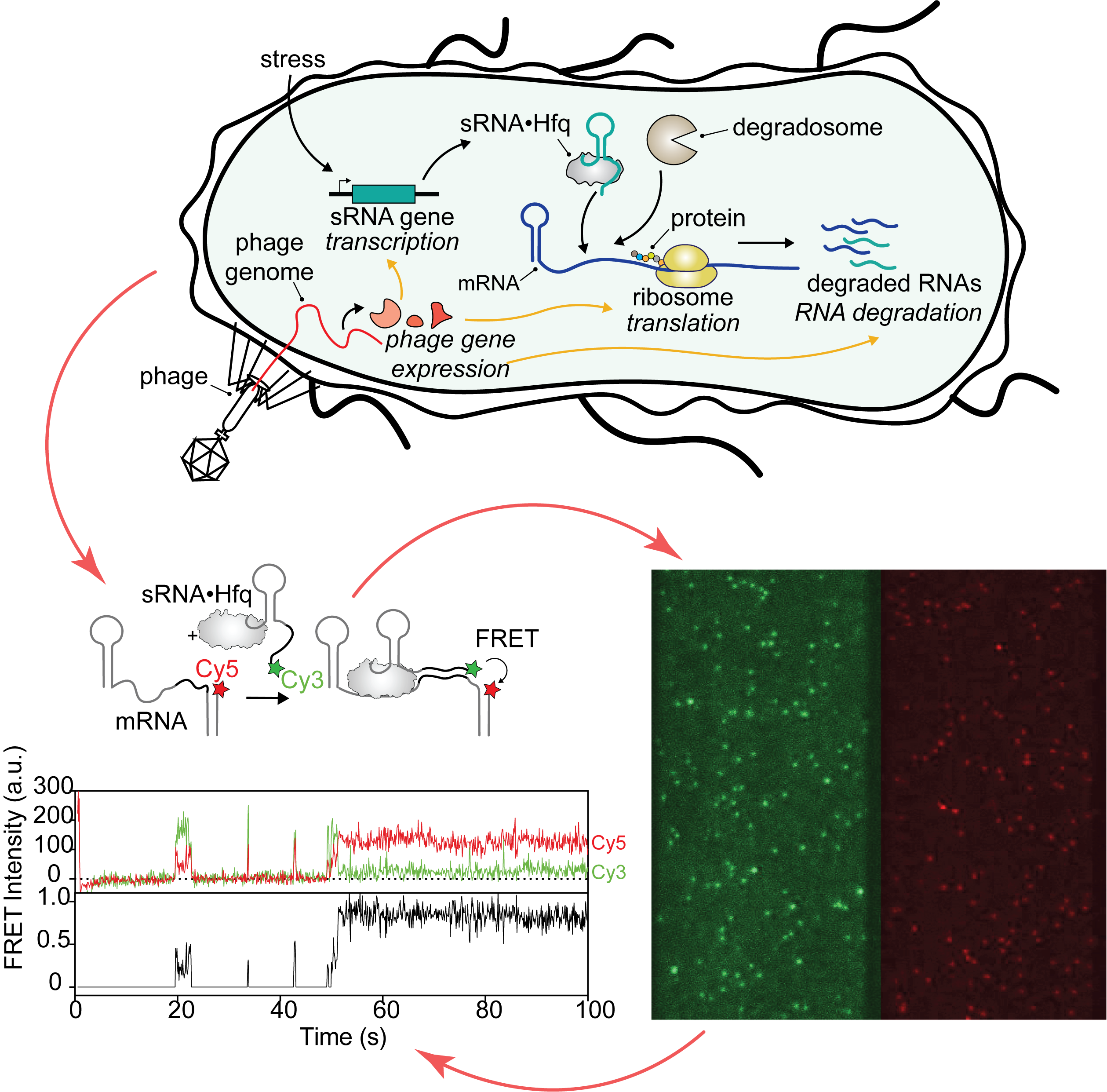
We combine molecular and systems-level approaches. At the single-molecule level, we use TIRF microscopy to observe the formation of RNA-protein complexes in real time. At the cellular level, we investigate how bacteriophages reprogram host RNA metabolism and translation, and how this knowledge may help identify new antimicrobial strategies.
We apply this integrated approach to commensal and pathogenic E. coli strains, as well as clinically relevant bacteria such as antibiotic-resistant Acinetobacter baumannii.
Research Summary
Our research programme focuses on the principles of bacterial gene expression regulation. At the molecular level, we use biochemical methods and advanced single-molecule TIRF microscopy to understand how small regulatory RNAs and the Hfq chaperone protein recognize their targets and control the fate of mRNA molecules.
By monitoring interactions between RNA, proteins, and ribosomes in real time, we study the basic principles of bacterial translational control and RNA degradation. We are interested not only in which molecules interact, but also when these interactions occur, in what order, and with what dynamics successive regulatory steps take place.
The second major research area concerns bacteriophage infection. We investigate how phages reprogram host RNA metabolism and translation. To do this, we use transcriptomics and proteomics to identify interaction partners and regulatory targets in bacterial cells.
In 2024-2025, we established experimental systems in antibiotic-resistant Acinetobacter baumannii and E. coli together with their phages. We also identified phage-encoded factors that modulate bacterial translation and RNA regulation. These studies are being developed through active, competitively funded research projects.
Scientific Impact
- Mechanistic insight: our work provides a mechanistic explanation of how small RNAs select their targets and coordinate gene silencing. By analysing the dynamics of target recognition, translation and RNA degradation, we move beyond static models of regulation and describe fundamental principles of gene expression control in bacteria.
- Advanced technology: we use state-of-the-art single-molecule microscopy to observe regulatory processes in real time. This makes it possible to simultaneously follow RNA targeting, translation and degradation.
- Potential applications: studies of phage-encoded factors acting on antibiotic-resistant bacteria may open new routes toward antimicrobial strategies against ESKAPE pathogens. Understanding sRNA design rules may also support the development of programmable bacterial regulators for synthetic biology, metabolic engineering and targeted therapeutic interventions.
Future Goals
In the coming years, we will connect fundamental discovery with therapeutic potential. Our goal is to extend single-molecule analyses to capture the full regulatory path of an mRNA molecule: from its initial recognition by sRNA-Hfq complexes to its final fate at the ribosome.
We will also use mechanistic insight to study the phage-host arms race in clinically relevant contexts, especially in ESKAPE pathogens.
Collaborations
- We collaborate with Prof. Sander Granneman from the University of Edinburgh to integrate single-molecule visualization with in vivo protein-RNA interaction mapping.
- We also collaborate with Prof. Ben Luisi from the University of Cambridge to connect regulatory dynamics with mechanisms of RNA degradation.
- Dr Tom Graefenhan from the Core Unit Systems Medicine in Wuerzburg supports us with transcriptomic analyses of phage infection.
Comment
"Our laboratory studies bacterial gene regulation in two main areas: first, how RNA-binding proteins and small RNAs control translation and couple it to RNA degradation; and second, how bacteriophages reprogram host RNA metabolism and translation. We combine single-molecule TIRF microscopy, which directly visualizes RNA-protein complex formation in real time, with high-throughput transcriptomics and proteomics. This allows us to identify interaction partners and regulatory targets in cells. " says Ewelina Małecka.
Visit the laboratory website for more details: https://maleckalab.com/
Publications and preprints from this group
Browse publications →
Group Leader:
Ewelina Małecka, PhD
Research Specialist:
Maciej Dylewski, PhD
PhD Students:
Ewa Izdebska
Aiswarya Mohan
Junior Research Scientist:
Daria Demina
Intern:
Sebastian Machera
MSc student:
Zuzanna Grzegorczyk
Laboratory Support Specialist:
Karolina Komorowska
Technician:
Katarzyna Kaca
 |
Ewelina Małecka, PhDCorrespondence address: |
DEGREES
2017 - PhD in Biochemistry with Prof. Mikołaj Olejniczak, Adam Mickiewicz University, Poznań, Poland
2012 - MSc in Biotechnology with Prof. Zofia Szweykowska-Kulińska, Adam Mickiewicz University, Poznań, Poland
PROFESSIONAL EXPERIENCE
2022 - present - Head of Laboratory of Prokaryotic Gene Regulation (former: Single-Molecule Biophysics), International Institute of Molecular and Cell Biology in Warsaw, Poland
2022 - present - Visiting Researcher, Dept. of Biochemistry, Johns Hopkins University, US
2017 - 2022 - Postdoctoral fellow with Prof. Sarah Woodson, Dept. of Biochemistry, Johns Hopkins University, USA
HONORS, PRIZES, AND AWARDS
2024-2029 EMBO Installation Grant
2023-2028 Sonata Bis grant (National Science Centre)
2023-present Member of the NAR Early Career Researcher Advisory Board
2022 - Invited panelist "Diverse Voices from Rising Scientists", RNA Society meeting, Boulder, USA
2022 - RNA Society Research Presentation Fellowship
2021 - Invited interview with Molecular Cell "Meet the authors", doi: 10.1016/j.molcel.2021.04.011
2021 - Early-career reviewer in Elife (Structural Biology and Molecular Biophysics)
2021 - Conference Award, RNA Society
2019 - Travel Award, RNA Society
2018 - Travelling Fellowship, The Company of Biologists
2015 - present - Member, RNA Society
2015-2018 Preludium grant (National Science Centre)
PUBLICATIONS BY DR. EWELINA MAŁECKA BEFORE JOINING IIMCB:
-
Małecka EM, Woodson SA.
RNA compaction and iterative scanning for small RNA targets by the Hfq chaperone.
Nat Commun. 2024 Mar 7;15(1):2069.
doi:10.1038/s41467-024-46316-6. - Sarni SH, Roca J, Du C, Jia M, Li H, Damjanovic A, Małecka EM, Wysocki VH, Woodson SA.
Intrinsically disordered interaction network in an RNA chaperone revealed by native mass spectrometry.
Proc Natl Acad Sci U S A. 2022 Nov 22;119(47):e2208780119.
doi: 10.1073/pnas.2208780119. -
Małecka EM, Hua B, Woodson SA.
Single-Molecule FRET Studies of RNA Structural Rearrangements and RNA-RNA Interactions.
Methods Mol Biol. 2022;2518:271-289.
doi: 10.1007/978-1-0716-2421-0_16. -
Małecka EM, Sobańska D, Olejniczak M.
Bacterial Chaperone Protein Hfq Facilitates the Annealing of Sponge RNAs to Small Regulatory RNAs.
J Mol Biol. 2021 Nov 19;433(23):167291.
doi: 10.1016/j.jmb.2021.167291. -
Malecka EM, Bassani F, Dendooven T, Sonnleitner E, Rozner M, Albanese TG, Resch A, Luisi B, Woodson S, Bläsi U.
Stabilization of Hfq-mediated translational repression by the co-repressor Crc in Pseudomonas aeruginosa.
Nucleic Acids Res. 2021 Jul 9;49(12):7075-7087.
doi: 10.1093/nar/gkab510. -
Małecka EM, Woodson SA.
Stepwise sRNA targeting of structured bacterial mRNAs leads to abortive annealing.
Mol Cell. 2021 May 6;81(9):1988-1999.e4.
doi: 10.1016/j.molcel.2021.02.019. -
Panja S, Małecka EM, Santiago-Frangos A, Woodson SA.
Quantitative Analysis of RNA Chaperone Activity by Native Gel Electrophoresis and Fluorescence Spectroscopy.
Methods Mol Biol. 2020;2106:19-39.
doi: 10.1007/978-1-0716-0231-7_2. -
Małecka EM, Woodson SA.
Ribosomes clear the way for siRNA targeting.
Nat Struct Mol Biol. 2020 Sep;27(9):775-777.
doi: 10.1038/s41594-020-0495-4. -
Santiago-Frangos A, Fröhlich KS, Jeliazkov JR, Małecka EM, Marino G, Gray JJ, Luisi BF, Woodson SA, Hardwick SW.
Caulobacter crescentus Hfq structure reveals a conserved mechanism of RNA annealing regulation.
Proc Natl Acad Sci U S A. 2019 May 28;116(22):10978-10987.
doi: 10.1073/pnas.1814428116. -
Małecka EM, Stróżecka J, Sobańska D, Olejniczak M.
Structure of bacterial regulatory RNAs determines their performance in competition for the chaperone protein Hfq.
Biochemistry. 2015 Feb 10;54(5):1157-70.
doi: 10.1021/bi500741d. -
Sobkowiak L, Bielewicz D, Malecka EM, Jakobsen I, Albrechtsen M, Szweykowska-Kulinska Z, Pacak A.
The Role of the P1BS Element Containing Promoter-Driven Genes in Pi Transport and Homeostasis in Plants.
Front Plant Sci. 2012 Mar 30;3:58.
doi: 10.3389/fpls.2012.00058.