




Our research aims to study how gene expression is regulated in the developing embryo and to examine its links to congenital malformations in humans. We focus particularly on heart development and disease, using classical genetics, experimental embryology, biochemistry, and bulk and single-cell genomics techniques in the zebrafish model organism (Danio rerio).
Research Summary
Embryonic development is orchestrated by highly precise regulatory mechanisms that ensure genes are expressed in the right cells, at the right time, and at appropriate levels. Understanding how this spatiotemporal control is achieved remains a central challenge in developmental biology.
In our laboratory, we investigate the fundamental principles of gene regulation during vertebrate development, using the zebrafish as a powerful in vivo model system. We focus on how cis-regulatory elements, chromatin accessibility, and higher-order genome organization interact with transcription factors to control gene-expression programs that drive cell-fate decisions and organ formation.
By combining genomics approaches with experimental embryology, genetics, and biochemistry, we aim to define gene-regulatory networks in their native developmental context and understand how disruptions in these mechanisms lead to human congenital disorders.
Our work places particular emphasis on cardiac development. Although many genes essential for heart formation and function have been identified, how their activity is coordinated across developmental time and integrated with epigenetic regulation remains incompletely understood. We focus on cardiomyocytes and cardiac pacemaker cells, investigating how distinct cardiac cell types emerge and acquire specialized functions.
Through large-scale transcriptomic and epigenomic analyses, including single-cell approaches, we have generated resources that reveal cellular diversity and regulatory elements in the developing heart. Ultimately, our research aims to bridge gene regulation, cellular differentiation, and organ function, contributing to a deeper understanding of cardiovascular development and its links to human disease.
Scientific Impact
- We generated comprehensive transcriptomic and epigenomic resources for the developing zebrafish heart, focusing on cardiomyocytes and rare cell types such as pacemaker cells.
- We established a single-cell atlas of the developing zebrafish heart, revealing previously uncharacterized cardiac cell types and their molecular profiles.
- We identified novel regulatory elements underlying cardiovascular development and disease.
- We developed and validated a computational tool for discovering human congenital heart disease-associated non-coding variants that affect gene regulation.
Future Goals
We aim to develop zebrafish models of human genetic diseases, particularly those driven by non-coding genetic variants. These models will enable in-depth investigation of disease mechanisms in a physiologically relevant in vivo context.
By integrating genome editing with transcriptomic and epigenomic profiling, we seek to directly link genetic variants to their effects on gene regulation, cellular identity, and cardiac function. Building on our expertise in gene-regulatory networks, we aim to dissect how disruptions in cis-regulatory elements and chromatin organization alter developmental trajectories, with a focus on cardiomyocytes and cardiac pacemaker cells.
We also aim to establish an integrated single-cell transcriptomic and epigenomic atlas of the developing heart, offering a unified view of regulatory landscapes across cell types and developmental stages. Ultimately, our goal is to bridge human genetic data with experimental biology, contributing to a more comprehensive understanding of the molecular basis of congenital heart diseases and informing future precision-medicine approaches.
Collaborations
We actively collaborate with research groups within IIMCB as well as with leading international laboratories in genomics and clinical genetics. We seek cross-disciplinary partnerships that integrate developmental biology with clinical research, methods development, and computational modeling, enabling us to connect fundamental mechanisms with disease relevance.
Comment
“Our research seeks to uncover the fundamental logic of gene regulation in development, with the ultimate goal of translating these insights to human health. Using zebrafish, a model with human-relevant developmental and genetic programs, we aim to understand how regulatory disruptions lead to congenital diseases and to guide future experimental and clinical studies,” says Cecilia Lanny Winata, PhD, DSc Habil.
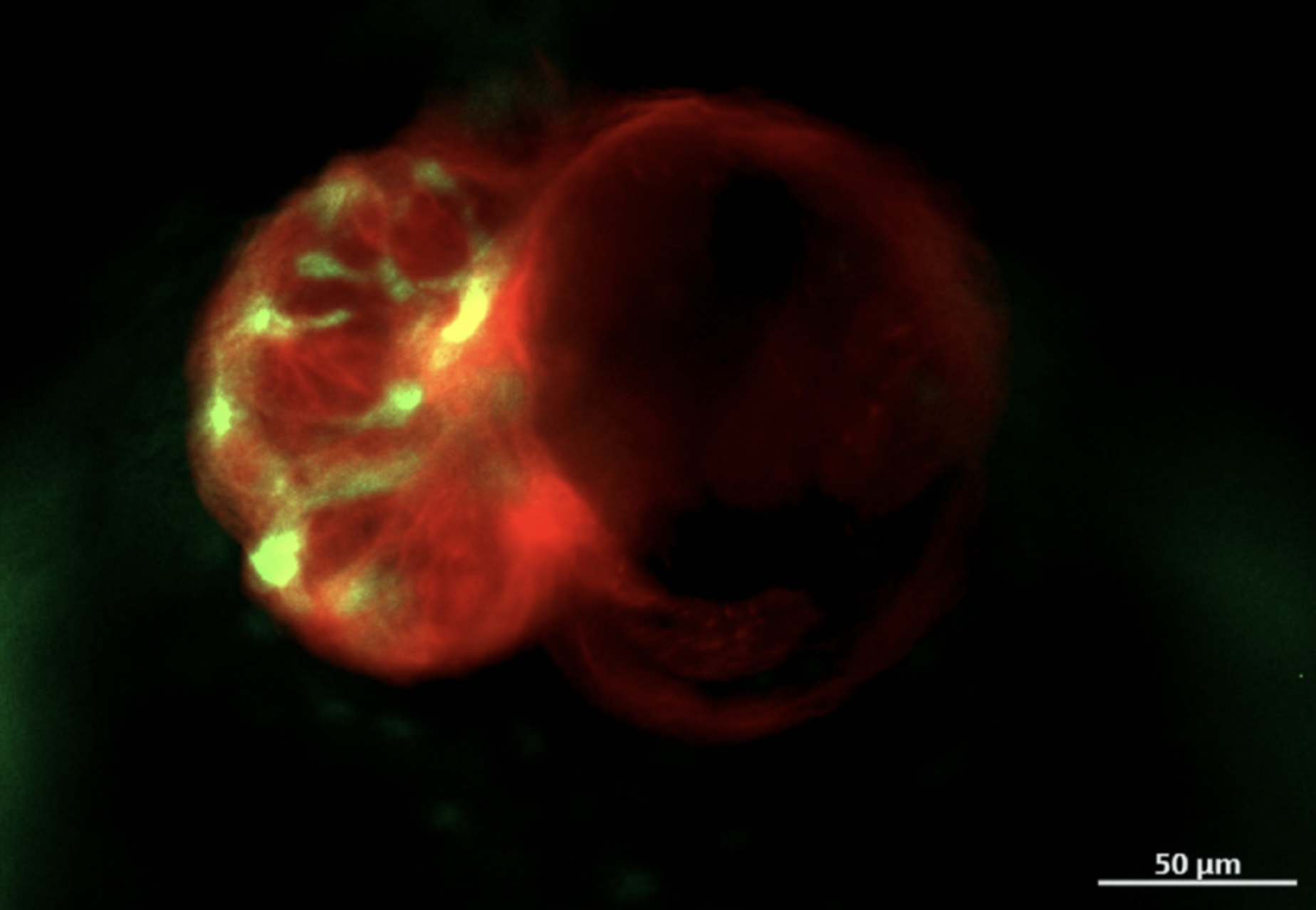
Cellular diversity of the myocardium. The zebrafish heart from the transgenic line Tg(myl7:mRFP) x Tg(-6.8got2b:cfos:EGFP) at 72 hours post-fertilization highlights distinct cardiomyocyte populations using dual fluorescent labeling. All myocardial cells are marked in red, while a specialized subset of trabecular cardiomyocytes is labeled in green. Green fluorescence is driven by a newly identified enhancer element, representing the earliest known molecular marker of trabecular cardiomyocytes and providing a vivid illustration of cellular diversity within the developing heart. Image by Costantino Parisi.
Laboratory Webpage

https://zfin.org/ZDB-LAB-141211-1
Publications and preprints from this group
Browse publications →
Lab Leader
Cecilia Lanny Winata, PhD, DSc Habil
Postdoctoral Researcher
Shikha Vashist, PhD (on maternity leave)
Lakshmi Priyankka Alagappan, PhD
PhD Students
Aman Suryan, MSc
Arunabha Sen, MSc
Mrudula Dileep, MSc
Research Technicians
Adrianna Pakuła, MSc
Konrad Kulesza, MSc
Lab Technician
Julia Kędzierska, MSc
Laboratory Support Specialists
Agnieszka Konkol, MSc (on maternity leave)
Patrycja Rojek, PhD
Internship Students
Pola Klinowska
Wojciech Mordań
 |
Cecilia Lanny Winata, PhD, Dsc HabilCorrespondence address: |
DEGREES
2021 - Dsc Habil in Biological Sciences, Nencki Institute of Experimental Biology, Polish Academy of Sciences, Warsaw, Poland
2009 - PhD in Biology, Department of Biological Sciences, National University of Singapore
2004 - BSc (Hons.) in Biology, Department of Biological Sciences, National University of Singapore
PROFESSIONAL EXPERIENCE
2014-present - Professor, Head, Zebrafish Developmental Genomics Laboratory, Max Planck/International Institute of Molecular and Cell Biology Research Group in Warsaw, Poland
2013-2014 - Research Associate, Genome Institute of Singapore (with a 2013 research visit to the laboratory of Prof. Peter Alestrom, Norwegian School of Veterinary Sciences, Oslo, Norway)
2009-2013 - Postdoctoral Fellow with Dr. Sinnakaruppan Mathavan, Genome Institute of Singapore
2004-2009 - Doctoral research with Prof. Gong Zhiyuan and Prof. Vladimir Korzh, Department of Biological Sciences, National University of Singapore
HONORS, PRIZES AND AWARDS
2016 - FIRST TEAM, Foundation for Polish Science
2016 - OPUS (as a partner), National Science Centre
2014 - OPUS, National Science Centre
2000-2004 - ASEAN Undergraduate Scholarship
2003 - Science Faculty Dean’s List, National University of Singapore