




At the Laboratory of RNA Biology – ERA Chairs Group, we investigate how RNA 3′-end metabolism shapes gene expression across cells and tissues. Our work focuses on poly(A) tails, mRNA stability and cytoplasmic polyadenylation, as well as the application of these mechanisms to the design of improved mRNA therapeutics. We combine genetics, animal models, structural biology, Oxford Nanopore direct RNA sequencing, advanced computational analysis and machine-learning approaches.
We discovered previously unrecognized, cell-type-dependent mechanisms that enhance the stability of both endogenous and therapeutic mRNAs, including molecules used in vaccines. Our goal is to define their molecular basis and translate this knowledge into design principles for more effective and precisely targeted mRNA therapeutics.
Research Summary
mRNA stability is a major determinant of how much protein is produced from a given RNA molecule. Poly(A)-tail dynamics play a central role: the tail is added in the nucleus and repeatedly remodelled in the cytoplasm. These tails are technically challenging to study because they are homopolymers whose length and nucleotide composition can change during the lifetime of an individual transcript.
We have developed an Oxford Nanopore direct RNA sequencing platform that analyses full-length native RNA molecules without amplification. This enables us to measure poly(A)-tail length and composition at single-molecule resolution and to investigate their dynamics in vivo across cell types, tissues and physiological models. We also developed Ninetails, a convolutional-neural-network tool that detects non-adenosine nucleotides within poly(A) tails directly from raw nanopore RNA-sequencing signals.
A major focus of the laboratory is the TENT5 family of cytoplasmic poly(A) polymerases. We showed that these metazoan-specific enzymes stabilise selected mRNAs, particularly transcripts encoding secreted and endoplasmic-reticulum-targeted proteins. TENT5 proteins have important functions in gametogenesis, bone formation, immune responses and the control of tissue-specific secretory programmes.
One of our key achievements was the discovery that TENT5A re-adenylates COVID-19 vaccine mRNA in immune cells. This process extends poly(A) tails, stabilises therapeutic mRNA, increases antigen production and improves vaccine efficacy. The findings revealed a host-encoded mechanism supporting mRNA medicines and point towards therapies tailored to the target cell type and the destination of the encoded protein.
Scientific Impact
- We established cytoplasmic poly(A) polymerases of the TENT5 family as important regulators of physiological processes.
- We demonstrated that TENT5A re-adenylates and stabilises SARS-CoV-2 vaccine mRNA, increasing antigen production and vaccine efficacy.
- We showed that poly(A)-tail metabolism is relevant not only to fundamental biology but also to the development of mRNA-based therapies.
Research Plans
Through the ERC Advanced Grant project “ViveRNA”, we investigate endogenous and therapeutic mRNA stability in vivo by combining precisely engineered mouse models, primary cells, direct RNA sequencing, synthetic biology and quantitative modelling of post-transcriptional processes.
One objective is to define tissue-specific “RNA stability codes”. Using knock-in models that enable controlled depletion of key RNA-decay enzymes, we will measure mRNA stability and deadenylation kinetics across organs and identify the mechanisms that establish distinct post-transcriptional environments in different tissues.
We are also developing a new research direction focused on the role of TENT5A in the hypothalamic–pituitary axis, investigating how cytoplasmic polyadenylation of transcripts encoding neurohormones and neuropeptides contributes to hormonal homeostasis and whole-organism physiology.
For therapeutic mRNAs, we will systematically examine how coding-sequence composition, UTR architecture, 5′-cap chemistry, localisation signals and poly(A)-tail design affect RNA stability and protein output. Machine-learning models trained on our in-house datasets will be used to derive design rules for specific cell types and protein classes, followed by functional validation in primary cells and in vivo models.
The laboratory coordinates the HERO consortium (Horizon for Excellence in Messenger RNA Applications in Immuno-Oncology) within the Virtual Research Institute. Together with our partners, we are developing chemical strategies to improve mRNA therapeutics and exploring their application in cancer immunotherapy.
Collaborations
We collaborate with Prof. Marcin Nowotny and Prof. Marta Miączyńska at IIMCB; Prof. Jacek Jemielity and Dr Joanna Kowalska at the University of Warsaw; and Prof. Dominika Nowis and Prof. Jakub Gołąb at the Medical University of Warsaw.
We also maintain collaborations focused on mRNA stability, including with Prof. Magdalena Dziembowska at the University of Warsaw; Prof. Bertrand Séraphin at IGBMC, France; Dr Agnieszka Tudek at the Institute of Biochemistry and Biophysics, Polish Academy of Sciences; Prof. Torben Jensen at Aarhus University, Denmark; and Prof. Grzegorz Kudla at the Human Genetics Unit, University of Edinburgh.
Awards and Recognition
The scientific achievements of Prof. Andrzej Dziembowski and his team have been recognized with numerous prestigious awards, including the Foundation for Polish Science Award, the Prime Minister’s Awards, and the Minister of Education and Science Awards. The laboratory’s publications are also regularly recognized, including with the Jakub Karol Parnas Award from the Polish Biochemical Society and in the IIMCB Best Papers Awards competition.
Research perspective
We aim to understand why mRNA stability and both the length and composition of poly(A) tails differ between tissues, and to use these rules to design more effective mRNA therapeutics tailored to specific cell types. To achieve this, we combine in vivo models, long-read sequencing and machine-learning approaches.
Visit the laboratory profile on X: https://twitter.com/DziembowskiLab
Publications and preprints from this group
Browse publications →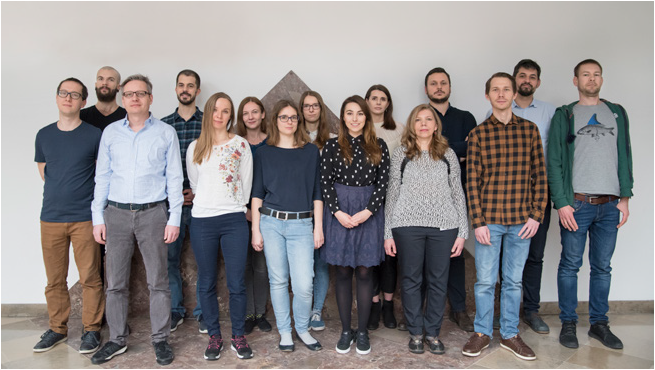
Lab Leader
Andrzej Dziembowski, PhD, Professor
Senior Scientist
Seweryn Mroczek, PhD Habil.
Bartosz Tarkowski, PhD
Postdoctoral Researchers
Agnieszka Czarnocka-Cieciura, PhD
Natalia Gumińska, PhD
Tomasz Kuliński, PhD
Kornel Labun, PhD
Michał Małszycki, PhD (EMBO fellow)
Michał Mazur, PhD
Research Assistant
Karolina Kasztelan, MSc
Senior Specialist
Kamila Affek, MSc
Ewelina Patrycja Owczarek, MSc
Julia Szeptycka, MSc
Agnieszka Machowska, MSc
Dominik Chwastek, MSc
PhD Students
Wiktor Antczak
Wiktoria Orzeł
Tola Tame
Magdalena Jawor
Senior Laboratory Technician
Alina Zielińska, BSc
Laboratory Support Specialist
Paula Kwapisz, MSc
Undergraduate students
Alicja Bień-Gryber
Alicja Stachurska
Julia Łucyn
Anna Modrzejowska
Wojciech Mordań

The Laboratory of RNA Biology - ERA Chairs Group has been established thanks to the EU H2020 funding within the ERA Chairs project entitled “MOlecular Signaling in Health and Disease - Interdisciplinary Centre of Excellence”, acronym: MOSaIC (GA no 810425)
 |
Andrzej Dziembowski, PhD, ProfessorCorrespondence address: |
 |
DEGREES
2014 - Professor of Biological Sciences, nomination by the President of the Republic of Poland
2009 - DSc Habil in Molecular Biology, University of Warsaw, Poland
2002 - PhD in Biology, cum laude, Department of Genetics Faculty of Biology, University of Warsaw, Poland
1998 - MSc in Molecular Biology, University of Warsaw, Inter-Faculty Individual Studies in Mathematics and Natural Sciences, Poland
PROFESSIONAL EMPLOYMENT
2019-present - Professor, Head of the Laboratory of RNA Biology - ERA Chairs Group, IIMCB, Warsaw, Poland (100% appointment)
2011-present - Associate Professor, Faculty of Biology, Department of Genetics and Biotechnology, University of Warsaw, Poland (currently 25% employment)
2014-2019 - Full Professor, Institute of Biochemistry and Biophysics PAS, Poland
2010-2014 - Associate Professor, Institute of Biochemistry and Biophysics PAS, Poland
2008-2010 - Assistant Professor, Institute of Biochemistry and Biophysics PAS, Poland
2006-2011 - Assistant Professor, Faculty of Biology, Department of Genetics and Biotechnology, University of Warsaw, Poland
2002 -2006 - Postdoctoral fellow, Centre de Génétique Moléculaire, CNRS, France
MEMBERSHIP IN SCIENTIFIC SOCIETIES, ORGANIZATIONS AND PANELS
2020 - Corresponding Member, Polish Academy of Sciences
2018 - EMBO Member
2004 - RNA Society Member
FELLOWSHIPS AND AWARDS
2018 - Prize for scientific achievements, Foundation for Polish Science
2014 - Master Award, Foundation for Polish Science
2013 - Ideas for Poland Award, Foundation for Polish Science
2013 - Knight's Cross of the Order of Polonia Restituta
2013 - Jakub Karol Parnas Award for the best publication in biochemistry, Polish Biochemical Society
2013 - National Science Centre Award for outstanding scientific achievements
2012 - Member, Polish Young Academy, Polish Academy of Sciences
2010 - Prime Minister Award for the habilitation thesis
2009 - Scholarship for outstanding young scientists, Minister of Science and Higher Education
2006 - EMBO Installation Grant
2002 - Postdoctoral fellowship, Foundation for Polish Science
2002 - Prime Minister Award for PhD thesis
2001 - Scholarship for Young Scientists, Foundation for Polish Science
DOCTORATES DEFENDED UNDER LAB LEADER’S SUPERVISION
K. Drążkowska, M. Lubas, A. Siwaszek, M. Ukleja, M. Czarnocki-Cieciura, O. Gewartowska, P. Krawczyk, E. Furmańczyk, A. Pyzik, T. Kuliński.
|
The Laboratory of RNA Biology - ERA Chairs Group has been established thanks to the EU H2020 funding within the ERA Chairs project |