




At the Laboratory of RNA-Protein Interactions - Dioscuri Centre, we study how RNA-binding proteins regulate gene activity, participate in antiviral responses, and influence processes relevant to human disease. We combine RNA biology, structural biology, mass spectrometry, live-cell experiments, and small-molecule approaches.
Our research focuses on two main areas: first, how RNA-binding proteins participate in the recognition of viral and therapeutic RNAs by the immune system; and second, how modulating RNA-protein interactions may help treat human diseases, particularly viral infections and Parkinson’s disease.
Research Summary
RNA is one of the fundamental molecules of life. It carries genetic information, participates in protein synthesis and performs regulatory and catalytic functions. To function properly, RNA depends on cooperation with RNA-binding proteins. These proteins regulate RNA processing, transport, stability and translation, thereby supporting the proper flow of genetic information in the cell.
RNA-protein interactions are also central to antiviral immunity. Some RNA-binding proteins recognize RNA molecules of viral origin and initiate immune responses, including the activation of interferon pathways. Disruption of these processes may facilitate viral infection, but it may also contribute to non-infectious diseases, including neurodegenerative disorders.
At the Dioscuri Centre for RNA-Protein Interactions in Human Health and Disease, we investigate how these interactions shape cellular systems. We are interested in how RNA-binding proteins recognize features of viral and therapeutic RNA, and how this knowledge can be used to design safer and more effective RNA therapies.
In the context of Parkinson’s disease, we focus on the regulation of alpha-synuclein by RNA-binding proteins and microRNAs. We ask whether modulating these interactions can restore proper gene-expression control and affect processes relevant to disease progression.
Scientific Impact
We deepen understanding of RNA-protein interactions as key regulators of innate immunity. Understanding these mechanisms may support the development of new antiviral strategies.
We identify molecular mechanisms linked to Parkinson’s disease and define potential therapeutic targets.
Translation
In 2024-2026, our research focused on RNA-protein interactions in innate antiviral defence and on safer RNA-based therapy. We showed that the 5′-terminal nucleotide influences the formation of immunogenic dsRNA by-products in RNA produced by in vitro transcription (Wolczyk et al., NAR 2025). Moreover, in June 2026, we published a paper showing that the 5′-terminal nucleotide also plays a critical role in the immune response to double-stranded RNA (Wolczyk et al., Mol Cell 2026). This knowledge opens the way to developing better antiviral therapies, treatments for autoimmune diseases, and emerging RNA-based therapies.
We also co-authored studies explaining the mechanisms and structures of the major antiviral protein TRIM25. We mapped the cellular effects of HuR inhibition and developed small-molecule approaches aimed at disrupting HuR-RNA complexes (Idlin et al., BMC Biol 2025).
In December 2025, the laboratory received a distinction from Division II of the Polish Academy of Sciences for the exceptional research achievement entitled "New mechanisms and therapeutic prospects in innate immune response to viruses and RNA based therapy".
Research plans
We plan to continue interdisciplinary research into the links between RNA biology and human disease. We will analyse the involvement of RNA-binding proteins in viral signalling pathways, which may lead to the identification of new antiviral strategies.
In parallel, we will expand our understanding of RNA regulatory pathways and search for chemical compounds capable of lowering alpha-synuclein levels in Parkinson’s disease.
Collaborations
- With Prof. Juri Rappsilber from Technische Universitat Berlin, we conduct mass-spectrometry-based studies, including proteome-wide analyses and structural studies. Prof. Rappsilber is the German partner of the Dioscuri Centre.
- With Prof. Andrzej Dziembowski from IIMCB and Prof. Gunther Hartmann from Bonn Medical University, we study the immunogenicity of therapeutic RNAs.
- With Dr Elżbieta Nowak and Prof. Marcin Nowotny from IIMCB, we analyse the structures of RNA-binding proteins.
- With Dr Katarzyna Mleczko-Sanecka from IIMCB, Dr Wojciech Pokrzywa from IIMCB and Prof. Tilo Kunath from the University of Edinburgh, we investigate the effects of compounds targeting RNA-binding proteins in cells and whole organisms.
- With Prof. Michele Vendruscolo from the University of Cambridge, we use artificial intelligence to screen for small molecules that inhibit RNA-binding proteins.
Comment
In 2024-2026, the laboratory focused on RNA-protein interactions in antiviral immunity and on the safer design of RNA therapies. Particular emphasis was placed on studies showing that the 5′ terminal nucleotide influences the immunogenicity of RNAs, as well as on work on TRIM25 and HuR proteins and on small-molecule modulation of RNA-protein complexes.
Project financed under Dioscuri, a programme initiated by the Max Planck Society, jointly managed with the National Science Centre in Poland, and mutually funded by the Polish Ministry of Science and Higher Education and German Federal Ministry of Research, Technology and Space.

"In my research, I unravel the intricate connections between RNA biology and human diseases, aiming to discover innovative approaches for next-generation treatments," - Prof. Gracjan Michlewski
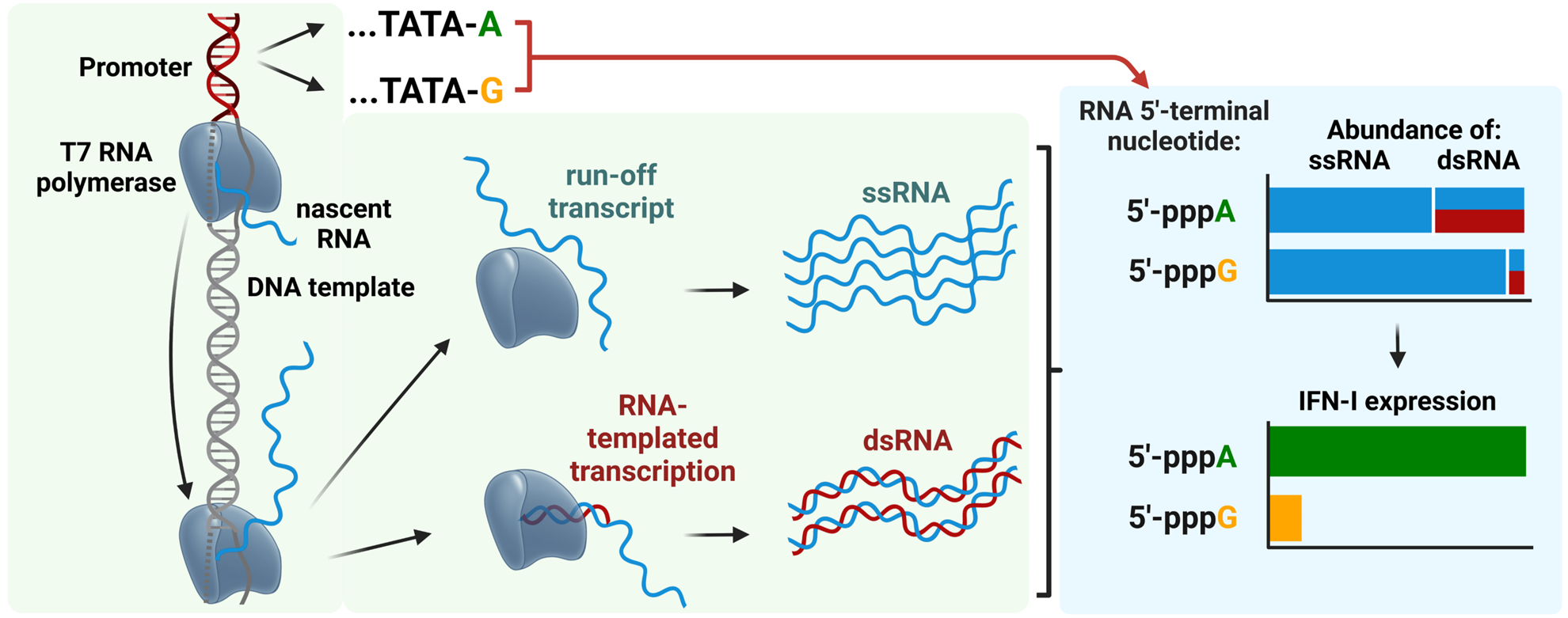
RNAs produced by in vitro transcription with 5′-pppA terminal nucleotide are more immunogenic than those with 5′-pppG due to higher levels of double-stranded RNA (dsRNA) that strongly activate the RIG-I/Interferon type 1 pathway https://doi.org/10.1093/nar/gkae1252.
Publications and preprints from this group
Browse publications →
Lab Leader
Gracjan Michlewski, PhD, Professor
Postdoctoral Researchers
Emilia Baranowska, PhD
Justyna Sobich, PhD
Ivan Trus, PhD
Magdalena Wołczyk, PhD
PhD Student/ Technican
Nathalie Idlin, MSc
Roohani Bajaj, MSc
PhD Students
Mouad Fakhri, Msc
Michał Lechowski, Msc
Zara Naz, Msc
Szymon Biela, MSc
Technican
Julia Kędzierska, MSc (part-time)
Laboratory Support Specialist
Lena Majchrowicz, PhD
Eliza Ratkowska, Eng
 |
Gracjan Michlewski, PhD, ProfessorCorrespondence address: |
|

DEGREES
2021 - Professor of Biological Sciences, nominated by the President of the Republic of Poland
2012 - DSc Habil in Biochemistry, Institute of Bioorganic Chemistry, Polish Academy of Sciences, Poznań, Poland
2005 - PhD in Biological Chemistry summa cum laude, Institute of Bioorganic Chemistry, Polish Academy of Sciences, Poznań, Poland
2001 - MSc in Biotechnology, Adam Mickiewicz University, Poznań, Poland
PROFESSIONAL EXPERIENCE
2024 - present - Head of the IIMCB Laboratory Leaders’ Council
2023 - present - Scientific Advisory Board Member, Institute of Biochemistry and Biophysics Polish Academy of Sciences
2021-2023 - Editorial Board Member, Communications Biology, Nature Group
2021-2023 - Honorary Lecturer, Infection Medicine, The University of Edinburgh, Edinburgh, United Kingdom
2021 - present - Professor, Head of Laboratory of RNA-Protein Interactions - Dioscuri Centre
2020 - Reader, Infection Medicine, The University of Edinburgh, United Kingdom
2018-2020 - Associate Professor, Zhejiang University-University of Edinburgh Institute, Haining, China
2018-2020 - Senior Lecturer, Infection Medicine, The University of Edinburgh, Edinburgh, United Kingdom
2011-2017 - Medical Career Award Fellow, Wellcome Trust Centre for Cell Biology, The University of Edinburgh, Edinburgh, United Kingdom
2005-2010 - Postdoctoral fellow, Human Genetics Unit, Medical Research Council, Edinburgh, United Kingdom
MEMBERSHIP IN SCIENTIFIC SOCIETIES AND ORGANIZATIONS
2024 - present – Member, Nucleic Acids Immunity Society
2008 - present – Member, RNA Society
1999-2001 – Head and Founder of Academic Students’ Society of Biotechnology, Poland
HONORS, PRIZES, AND AWARDS
2025 - Polish Academy of Sciences, Division II, Distinction for an exceptional research achievement entitled "New mechanisms and therapeutic prospects in innate immune response to viruses and RNA based therapy”
2024-2028 - OPUS 25, National Science Centre
2021 - 2025 - Polish Returns Programme, Polish National Agency for Academic Exchange
2021 - 2025 - Dioscuri Centre for RNA-Protein Interactions in Human Health and Disease, The Max Planck Society and The National Science Centre Poland
2020 - AIMS Award, Atomwise
2019 - 2022 - Project Grant, UK Government’s Biotechnology and Biological Sciences Research Council
2018 - Award, Moray Endowment Fund
2017 - 2019 - Seed Award in Science, Wellcome Trust
2017 - Travel Grant, RNA Society
2011 - 2015 Career Development Award, Medical Research Council
2010 - Scholarship, Keystone Symposia
2010 - International Travel Grant, The Royal Society
2008 - Scholarship, Keystone Symposia
2004 - 2006 - Award for Scientific Achievements, Polish Genetic Society
2001 - Fellowship Award, Minister of Polish National Education
2001 - Fellowship Award, Adam Mickiewicz University Foundation
DOCTORATES DEFENDED UNDER LAB LEADER’S SUPERVISION
J.S. Nowak, B. Özkan, G. Heikel, A. Downie Ruiz Velasco, Zhu S, J. Szymański.
See more: Dioscuri Centre for RNA-Protein Interactions in Human Health and Disease
