




We study epigenetics, specifically nucleic acid and histone modifications that influence cell fate change and maintenance. We use a broad spectrum of methods - from different variants of high-throughput sequencing, through classical biochemistry and structural biology, to large-scale data analysis. Our research is relevant to oncology, particularly to understanding hematologic malignancies in which epigenetic disruption plays an important role.
Research Summary
Our work focuses on 2'-deoxynucleotide modifications and metabolism. We are interested in the integrity of the 2'-deoxynucleotide pool and its potential consequences for epigenetics, particularly in developmental biology and cancer biology contexts. More recently, we have also initiated projects on amino acid metabolism, again in a cancer context.
The main biological theme of our projects is hematological malignancies. We study, among others, mixed lineage leukemia (MLL), acute myeloid leukemia with complex karyotype (CK-AML), and asparaginase treatment in acute lymphoblastic leukemia (ALL).
Methodologically, the group uses biochemistry and structural biology, but increasingly also relies on high-throughput sequencing and animal models. This allows us to test the relevance of biochemical concepts in a more physiological setting.
Scientific Impact
- We have contributed to the understanding of DNA modification pathways.
- We have identified enzymes that balance or sanitize the 2'-deoxynucleotide pool.
- We have contributed molecular insights to the biology of MLL and CK-AML.
- In our work on CDADC1, we showed that human CDADC1 is a (d)CTP-specific deaminase. High-resolution structures explained the enzyme's substrate specificity, while genetic experiments in mice showed that loss of Cdadc1 is well tolerated, even in the absence of Dctd.
Future Goals
We would like our work to have clinical impact in the future. For this reason, we are developing new clinical collaborations that should help connect our discoveries more closely with the biology of hematological diseases and potential practical applications.
Collaborations
We collaborate with academic partners, including Prof. G. Xu, Prof. J. Weng, Dr. T. Jurkowski, Dr. T. Hore, Dr. C. Winata, and Dr. A. Wlodawer, as well as with industry representatives, including Dr. P. Weigele. The group is also developing clinical collaborations with Dr. K. Gawle-Krawczyk, Prof. A. Kraemer, Prof. F. Stoelzel, Dr. T. Bochtler, Prof. A. Stenzinger, Prof. O. Neumann, and Dr. D. Kazdal.
Comment
“After many years of doing purely basic research, it would be nice to also have a practical impact,” says Prof. Matthias Bochtler.
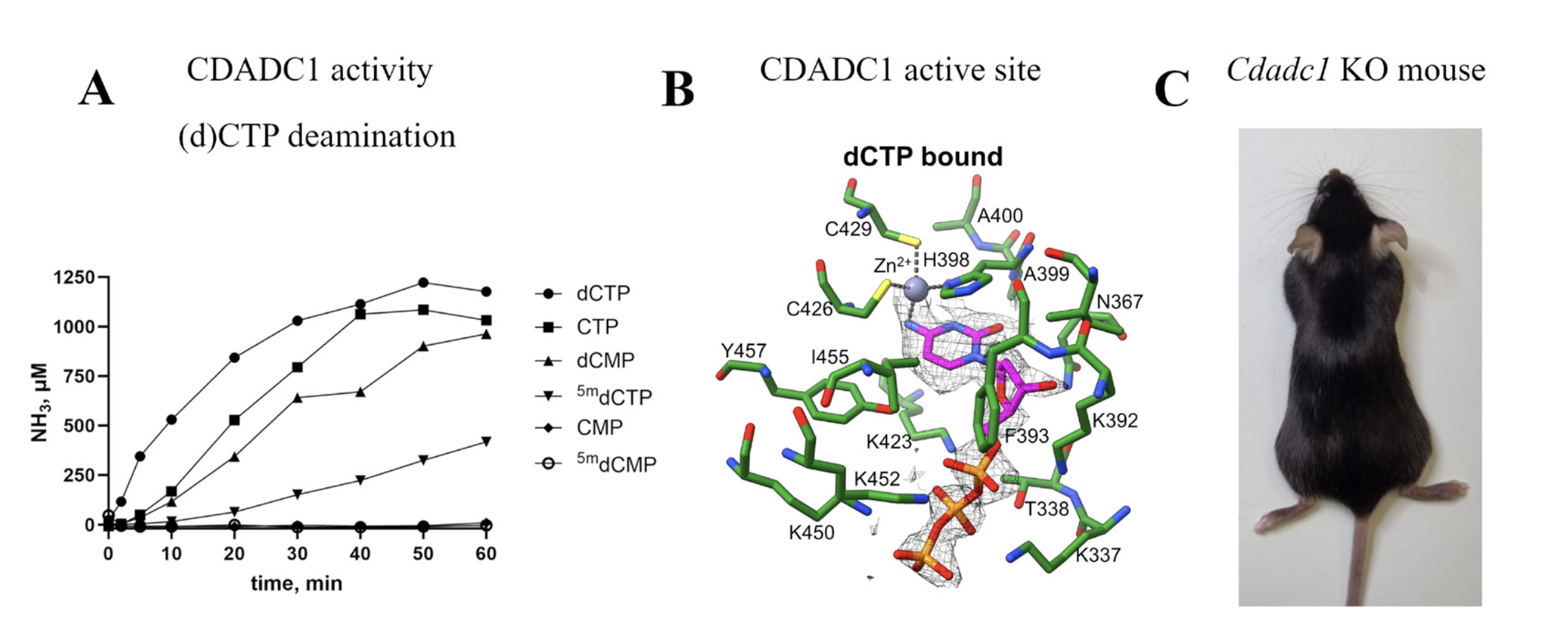
The team studies epigenetics, nucleic acid modifications, and 2'-deoxynucleotide metabolism, as well as their relevance to cell-fate stability and the development of hematological malignancies. The illustration presents the activity, structure, and function of vertebrate CDADC1: its activity as a (d)CTP deaminase, the structural basis of triphosphate specificity, and observations from the Cdadc1 KO mouse model.
Publications and preprints from this group
Browse publications →Head of Laboratory
Prof. Matthias Bochtler
Senior Researcher
Honorata Czapińska, PhD, DSc Habil.
PhD students
Nashat Akhtar, MSc
Terry Karimi, MSc
Research Specialist
Natalia Leśniowska, MSc
Lab Technician
Julia Kędzierska, MSc
Volunteer
Dominik Rafalski, PhD
Laboratory Support Specialist
Katarzyna Grzelak, PhD
Contact
 |
Matthias Bochtler, PhD, ProfessorCorrespondence address: |
DEGREES
2009 - Professor of Biological Sciences, nomination by the President of the Republic of Poland
2006 - DSc Habil, Institute of Bioorganic Chemistry, Polish Academy of Sciences, Poznań, Poland
1999 - PhD in Biochemistry, Technical University of Munich, Germany
1995 - MSc in Experimental Physics, Munich University, Germany
PROFESSIONAL EMPLOYMENT
2011-present - Professor, Head of Laboratory of Structural in Biology, International Institute of Molecular and Cell Biology in Warsaw, Poland, and Laboratory of Genome Engineering, Institute of Biochemistry and Biophysics, Polish Academy of Sciences,Warsaw, Poland
2007-2011 - Part-time Director of Structural Biology, Cardiff University, United Kingdom
2001-2010 - Head, Joint MPG-PAS Junior Research Group, International Institute of Molecular and Cell Biology in Warsaw, Poland
2000 - Patent training, Weickmann & Weickmann
1999-2000 - Postdoctoral Fellow, Max Planck Institute of Biochemistry, Martinsried, Germany
RESEARCH TRAINING
1996-1999 - Research Assistant, Max Planck Institute of Biochemistry, Martinsried, Germany
1995-1996 - Internship, Medical Microbiology, University of Regensburg, Germany
1992-1993 - Guest Student, Cambridge University, United Kingdom
1990-1992 - Studies in Physics, Munich University, Germany
HONORS, PRIZES AND AWARDS
2023 - Minister of Education and Science Award for significant achievements in scientific activities
2023 - Włodzimierz Krzyżosiak Distinction awarded by the Polish Academy of Sciences
2018 - TEAM Foundation for Polish Science
2018 - International Academic Partnerships Programme, Polish National Agency for Academic Exchange
2018 - DAINA, National Science Centre
2015 - HARMONIA, National Science Centre
2012 - MAESTRO, National Science Centre
2011 - TEAM, Foundation for Polish Science Professor Stefan Pieńkowski Award
2004 - EMBO/HHMI Young Investigator Award
2000 - Crystal Award, Germany
1998 - Crystal Award Germany
1990 – 1992 - Scholarship from Deutsche Studienstiftung and Bavarian State
DOCTORATES DEFENDED UNDER LAB LEADER’S SUPERVISION
R. Filipek, M. Firczuk, M. Lipka, R. Szczepanowski, M. Kaus-Drobek, M. Sokołowska, G. Chojnowski, H. Korza, M. Wojciechowski, W. Siwek, P. Haniewicz, A.A. Kazrani, K. Mierzejewska.